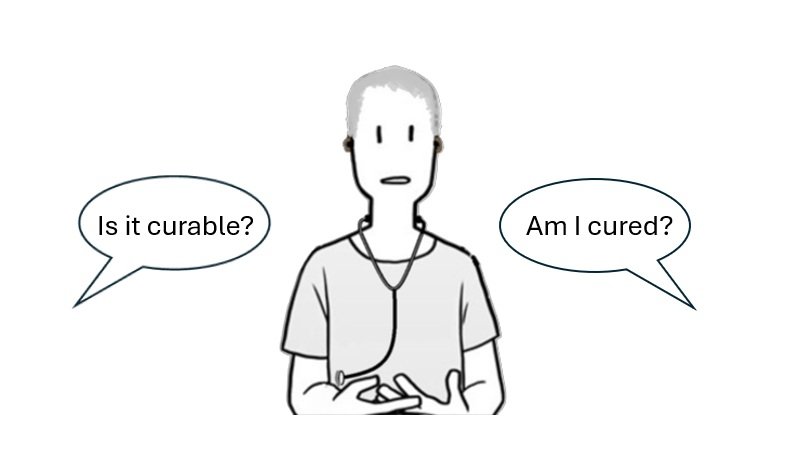
Newly diagnosed patients may ask, “Is it curable?” After completing treatment and achieving remission, they may ask, “Am I cured?” Patients think they are asking a simple question. They aren’t, which is why oncologists often avoid using this other C word in conversations with patients. But understanding what “cure” is—and isn’t—is key to tapping into its power in healthy ways. Here’s a primer:
#1: In medicine, cure means something different from how people use it in ordinary conversation. Technically, it is a statistical projection about remission based on groups of patients—and not a guarantee that the disease is gone forever for a specific patient.
To be cured, a patient’s cancer must remain in complete remission long enough for that type of cancer such that the chance of it coming back is no greater than if that patient had never developed it.
#3: Curing a patient’s cancer does not cure the uncertainty about that patient’s future health.
#4: To optimize health outcome, cancer must be treated in the context of a patient’s overall health.
To manage the uncertainty of remission after completion of treatment, remember:
Cancer didn’t make life uncertain. It exposed life’s uncertainty.
You don’t need to be cured to live your life.
Focusing on healing charts a path to the best outcome.
For a complete discussion, check out my online presentation:
FINDING THE BEST WORDS TO TALK ABOUT “CURE”