
A common habit that feeds stress may sabotage efforts to achieve goals and find peace.
Neuropsychiatrists have explored how interruptions in attention (e.g., responding to cell-phone news alerts and answering emails) hamper work performance and creativity. Even listening to background music can create cognitive load.
A Psychology Today article references “attention residue”—the lingering cognitive activation that remains after we shift from one task to another. If trying to switch back to a project after a quick check of email or social media, our thinking may be impaired compared to without the self-interruption.
A similar—and new to me—idea grabbed my attention. In Inside the Box. How Constraints Make Us Better, American journalist, David Epstein, describes “tension residue,” an evocative label for the leftover mental effort and pressure after solving a problem. He makes a compelling case that multitasking (which, in fact, is rapid switching of attention among various tasks) causes hormonal and neurological changes associated with increased stress.
The takeaway: Minimizing self-interruptions avoids accumulation of tension residue and attention residue.
To make better use of my writing time, I need to find ways that work for me to block emails and texts (except those that are urgent), and escape the lure of social media. So, too, when doing daily tasks. Otherwise, suboptimal performance and chronic stress increase the risk of making mistakes that add more stress, snowballing into greater problems and distress.
All that said, I was pleased to learn that a habit of mine is a good one! When writing for hours at a time, I take periodic breaks to play a quick puzzle, such as Spelling Bee. Epstein explains that such small, focused tasks flush out excess glutamine that builds up in the brain and causes mental fog and impaired thinking during long periods of productive and creative work. Note: The brain experience of such puzzle-solving is different from that of checking email or doomscrolling.
As a Healthy Survivor, consider taking steps to decrease tension residue and attention residue buildup caused by self-interruptions.
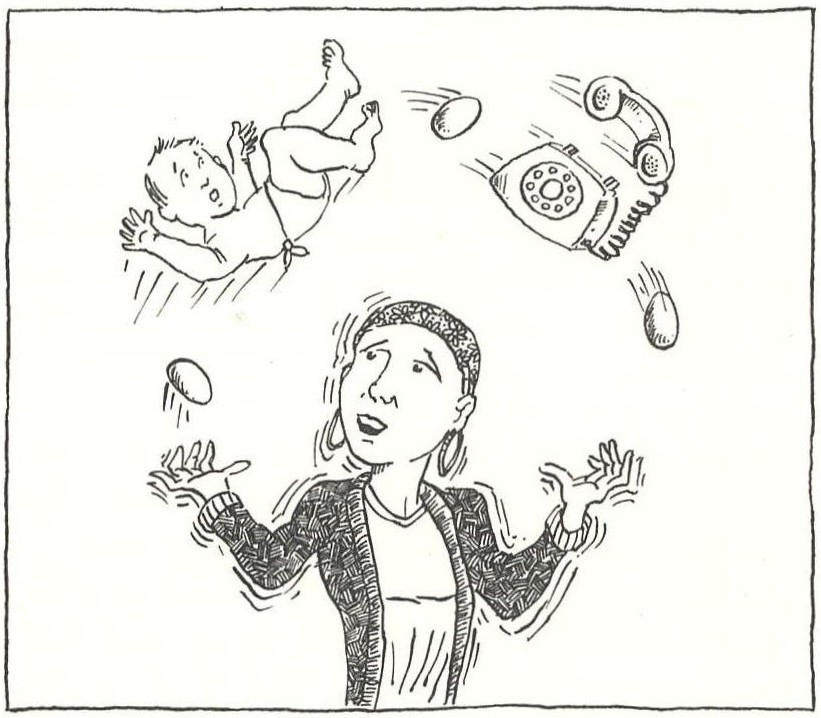
Jonas Kulikauskas, illustrator
Becky and the Worry Cup (WS Harpham; HarperCollins)